

President Bola Ahmed Tinubu has directed the Federal Competition and Consumer Protection Commission, FCCPC, to investigate major global technology companies over allegations of anti-competitive practices and the unlawful exploitation of news content belonging to Nigerian media organisations. The directive was contained in an official FCCPC release issued on Monday, 6 July 2026.
The investigation will cover Meta, Alphabet, owners of Google, X formerly Twitter, and certain Generative Artificial Intelligence platforms operating in Nigeria. According to the Commission, the companies are being examined for potentially unfair market conduct, including practices capable of undermining fair competition and the commercial viability of Nigerian media. The FCCPC said the probe was sequel to a joint petition submitted to the Presidency by the Nigerian Press Organisation, NPO. The NPO comprises the Newspaper Proprietors’ Association of Nigeria, NPAN, the Nigeria Union of Journalists, NUJ, the Broadcasting Organisations of Nigeria, BON, and the Guild of Corporate Online Publishers, GOCOP. The Federal Government’s position was communicated to the FCCPC in a letter signed by the Minister of Information and National Orientation, Alhaji Mohammed Idris.
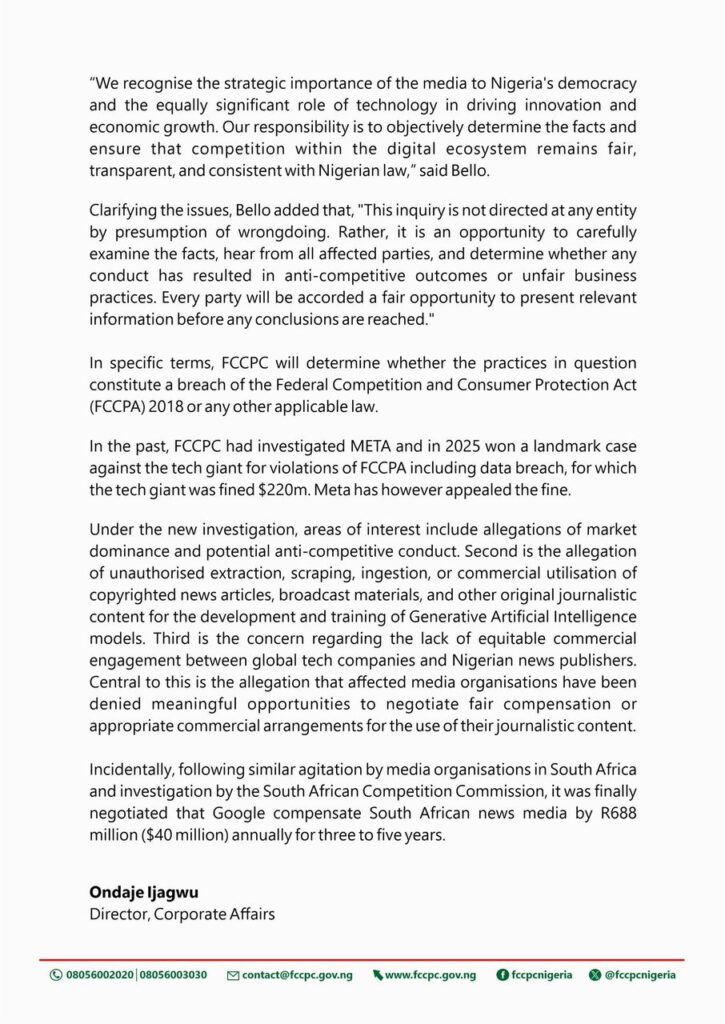
In recent years, Nigerian media bodies have raised concerns over the growing impact of digital platforms on the sustainability of the country’s news ecosystem. Specifically, the NPO told the Presidency that it is increasingly uncomfortable with how big tech platforms operate in Nigeria. The concerns include allegations of unauthorized extraction, scraping, ingestion and commercial utilisation of copyrighted news articles, broadcast materials and other original journalistic content for the development and training of Generative AI models. The media bodies also raised issues around market dominance and the lack of equitable commercial engagement between global tech companies and Nigerian news publishers, arguing that media organisations have been denied meaningful opportunities to negotiate fair compensation or appropriate commercial arrangements for the use of their content.
Reacting to the directive, the Executive Vice Chairman and Chief Executive Officer of the FCCPC, Mr. Tunji Bello, reaffirmed the Commission’s commitment to conducting an independent, transparent and evidence-based investigation. He said the inquiry promises to open a new vista in Nigeria’s media history. “We recognise the strategic importance of the media to Nigeria’s democracy and the equally significant role of technology in driving innovation and economic growth. Our responsibility is to objectively determine the facts and ensure that competition within the digital ecosystem remains fair, transparent, and consistent with Nigerian law,” Bello stated.
The FCCPC boss further clarified that the investigation is not based on any presumption of guilt. “This inquiry is not directed at any entity by presumption of wrongdoing. Rather, it is an opportunity to carefully examine the facts, hear from all affected parties, and determine whether any conduct has resulted in anti-competitive outcomes or unfair business practices. Every party will be accorded a fair opportunity to present relevant information before any conclusions are reached,” he added. The Commission said it will specifically determine whether the practices in question constitute a breach of the Federal Competition and Consumer Protection Act, FCCPA 2018, or any other applicable law.
The FCCPC noted that it has previous experience dealing with big tech. In 2025, the Commission won a landmark case against Meta for violations of the FCCPA, including data breach, for which the company was fined $220 million. Meta has however appealed the fine. To provide global context, the Commission cited a similar development in South Africa. Following agitation by media organisations and an investigation by the South African Competition Commission, Google agreed to compensate South African news media R688 million, about $40 million, annually for three to five years.
With this new investigation, Nigeria joins countries such as Canada, Australia and members of the European Union that are seeking regulatory frameworks to ensure that global technology platforms pay for and fairly engage with local news publishers whose content they use and monetize.





Leave a Reply